
Putnam Projected and Actual Dates
A projected release date is a calculation or decision point based on the sentence record then in force. The actual release date is when custody physically ends in the named system. Those dates can differ because credits, discipline, added cases, detainers, court action, board action, or ordinary release processing can change the result.
A Putnam County pretrial detainee does not have a sentence endpoint. Bond may permit release, but payment and all required checks must occur first. A hold in another case can keep the person in custody. For a sentenced person, begin with the court’s signed journal entry, since it identifies the term, sentence structure, and jail-time credit.
A detainer is a request or legal basis for another authority to hold or receive a person. It can prevent a community release even when one sentence ends. A transfer date also ends custody in one facility while custody continues elsewhere.
Putnam Custody System Lookup
The projected date must come from the custodian that controls the sentence. The Putnam County released inmate search identifies the county, state, or federal path when that authority is unclear. A county booking alone should not be used to calculate an ODRC term.
Find Putnam Release Dates
The correct lookup changes with custody. ODRC is for people committed to Ohio state prison. The Putnam County Jail and county courts control local jail records. A person who never entered ODRC may not appear in its search.
- Find the Putnam Municipal or Common Pleas case and read the signed sentencing entry.
- Identify whether the person is pretrial, serving a local jail term, committed to ODRC, or under a federal authority.
- For ODRC custody, search by offender number when known. Otherwise use last and first name, then match the sentencing county and case.
- Open the detail and read the exact status, effective sentence date, jail-time credit, sentence terms, and “Expected Release Date/Parole Eligibility Date” field.
- For a local jail sentence, ask the Sheriff for the written sentence calculation and release record, then compare it with the court entry.
- Check for later court orders, consecutive terms, detainers, board action, and supervision that could qualify the date.
- Confirm physical release with the agency rather than treating the projection as final.
The Ohio DRC Offender Search accepts an A, R, or W-prefixed six-digit offender number and name fields. Use “All” when status is uncertain so a Released, APA Supervision, or current result is not hidden.
The official search screen shows the filters used for a Putnam County state-prison lookup.
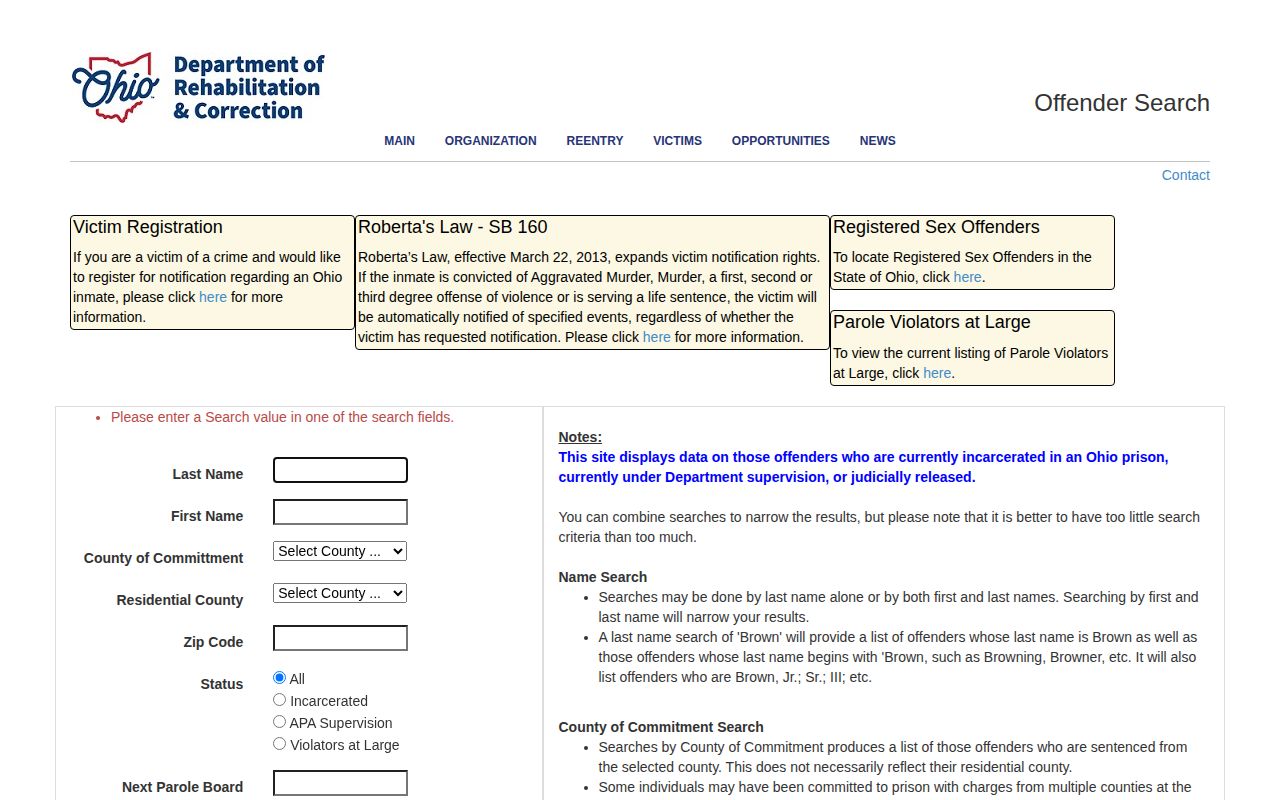
The live detail, not the blank form, carries the date and sentence information. Save the access date because the record can be recalculated.
Putnam ODRC Date Fields
ODRC detail records combine identity, sentence, custody, and hearing facts. Not every person has every field. Match the offender number, sentencing county, and case before interpreting a date. County of Commitment means the committing county, not current residence or institution.
| Field | Why it matters |
|---|---|
| Offender number | Links the detail to one ODRC identity. |
| Status | Shows whether ODRC reports incarceration, release, APA supervision, or another listed state. |
| Sentencing county and case | Connects the ODRC sentence to the Putnam court journal. |
| Effective sentence date | Marks the sentence calculation starting point shown by ODRC. |
| Jail-time credit | Shows qualifying confinement credited toward the sentence. |
| Sentence terms | Identifies definite, indefinite, concurrent, consecutive, or other controlling structure. |
| Expected Release Date/Parole Eligibility Date | Uses a combined label whose meaning depends on the sentence type. |
| Hearing information | May show the next board review month and latest hearing type or result. |
The ODRC definitions page supplies the agency’s meaning for date and status fields.
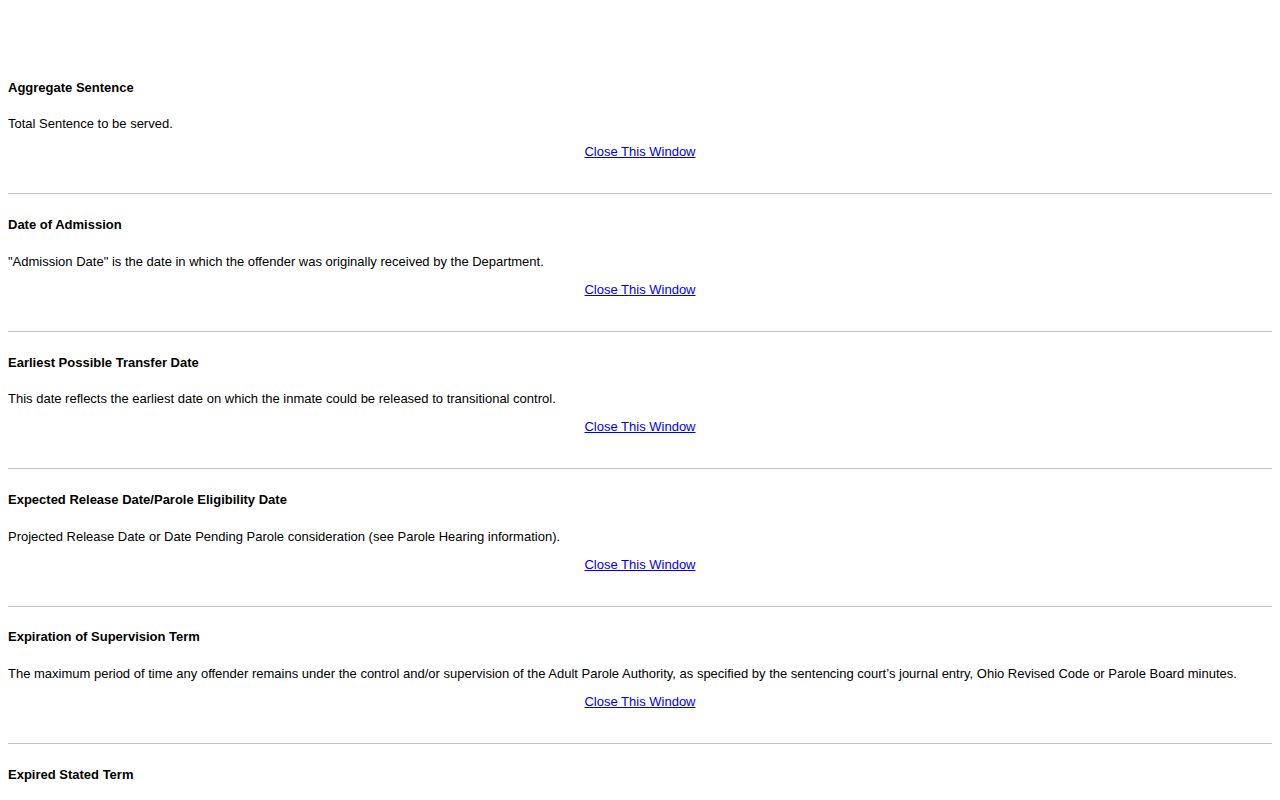
Those definitions prevent a first eligibility point from being described as a guaranteed release. Quote the displayed label exactly and apply the definition tied to that sentence.
Note: ODRC’s last recorded address is not proof of a person’s current location and should not be used to interpret release timing.
Putnam’s Combined ODRC Date
Ohio places two concepts in one exact label: “Expected Release Date/Parole Eligibility Date.” That wording is a key Putnam County research issue. For a definite term, the field may function as an expected endpoint based on the current calculation. For an indefinite or parole-eligible sentence, it may identify when the board can first consider release.
Eligibility is permission for consideration, not a grant. The Ohio Parole Board may grant release with a projected date, continue the matter, deny release, defer for more information, or rescind an earlier action before release. Final ODRC processing still controls the physical event.
The sentencing journal should show the offense date, felony level, definite or indefinite structure, mandatory parts, concurrent or consecutive terms, and effective date. Those facts determine which meaning applies. Never shorten the ODRC label to “release date” when the record itself preserves the parole distinction.
Ohio Credit for Putnam Sentences
ORC 2967.194 establishes Ohio’s current earned-credit framework for qualifying people confined on or after April 4, 2024, with transition rules for earlier confinement. The statute provides provisional monthly credit of one or five days for productive participation depending on the category. It also permits specified completion credit for eligible people. Ordinary participation and completion credit under the cited division, apart from the separate completion category, is capped at 15 percent of the stated term.
Eligibility exclusions are substantial. Mandatory or nonreducible terms specified by law, death sentences, aggravated murder or murder and related offenses, life without parole, Chapter 2971 terms, and specified sexually oriented offenses are among the categories addressed. Credits are provisional and may be denied or withdrawn for rule violations before becoming final through ODRC review.
ORC 2967.191 governs credit for qualifying days already spent in confinement. ODRC may show this jail-time credit on the person’s detail. It is not the same as earned program credit. Both must be tied to the actual sentence record.
Ohio’s 15 percent participation-credit cap sometimes produces an “85 percent” shorthand. That phrase is not a universal release rule. Sentence type, mandatory portions, statutory exclusions, completion credits, jail-time credit, judicial release, older law, and indefinite-term rules can all change the calculation.
Putnam Indefinite Sentence Dates
ORC 2967.271 covers Ohio’s non-life felony indefinite-term framework and defines a presumptive earned early release date. It cannot be reduced to one percentage. The minimum and maximum terms, earned credit, possible court reduction, and ODRC rebuttal or extension procedures must be read together.
For parole sentence categories, ORC 2967.13 governs first eligibility. Life without parole and Chapter 2971 terms are excluded. OAC 5120:1-1-03 addresses when an indefinite-sentence prisoner may first be paroled, including applicable reductions under the controlling law. OAC 5120:1-1-10 addresses hearings and projected dates in board records.
A scheduled hearing month is not a release month. Check the latest hearing result, official board record, current ODRC status, and Putnam sentencing journal. Consecutive terms can move eligibility, and a favorable board action can still be changed before physical departure.
Putnam County Jail Calculations
ODRC earned-credit rules should not be applied automatically to a Putnam County jail sentence. Begin with the Municipal or Common Pleas sentencing entry, including any jail-time credit. Then ask the Sheriff for the written local policy and the existing sentence-calculation or release record.
No published Putnam County jail good-time policy was found in the research. No official weekend or holiday early-release rule was found either. That gap must remain explicit. It is not sound to borrow a state-prison rate or another county’s practice.
A court-ordered endpoint can still differ from physical release because staff must complete processing and check for another hold. Bond may also authorize release without fixing the exit time. If a date has passed but the person remains held, ask the jail which active authority controls custody and read each open case.
Can ODRC’s earned-credit formula calculate a Putnam jail date?
No. Use the local sentence, jail-time credit, Sheriff policy, and release record unless the person was committed to ODRC.
Why Putnam Release Dates Change
A projected date is a snapshot of the controlling facts. Later events may alter the calculation or the type of custody that follows. The source record should identify which factor applies rather than leaving the change to guesswork.
| Factor | Possible effect | Record to check |
|---|---|---|
| Earned credit | May move an eligible calculated date earlier after final review. | ODRC sentence computation and ORC 2967.194 |
| Credit denial or withdrawal | Can remove provisional time after rule violations. | ODRC calculation and public disciplinary information |
| Jail-time credit correction | Changes the amount of qualifying prior confinement applied. | Court entry and ODRC detail |
| Additional or consecutive sentence | Can extend the controlling term. | Sentencing journals and ODRC terms |
| Detainer or hold | May send the person to another custodian instead of the community. | Jail, court, and receiving-agency records |
| Judicial or board action | May grant, deny, continue, reduce, or rescind a projected event. | Court journal or Parole Board record |
| Release processing | Can make physical departure later than an authorization time. | Facility release record |
Quote the updated date and the date accessed. If a discrepancy is contested, request the public sentence chronology and computation fields from ODRC or the Sheriff, then compare them with the court order.
Confirm Putnam Actual Release
Use Ohio VINE for a pending custody-event alert, but do not rely on it alone. Feed timing follows the source agency and an alert can arrive after release. The Putnam County VINE Inmate Check explains how to match one record and register by phone, email, or text.
For state prison, confirm the final status with ODRC and the sentencing court. “APA Supervision” means the person is outside prison but remains under Adult Parole Authority supervision. “Released” must still be read with sentence and supervision fields. A violator-at-large status is not a successful discharge.
For the county jail, call 419-523-3407 for current physical status and request the booking/release record for the exact date and time. The court order explains the legal authority, while the jail record proves the departure. Keep both when the projection and actual event differ.
Note: Physical release, transfer to another custodian, start of supervision, and final discharge are four separate events.